Masayoshi Son has in no way been a man of small
intentions. The SoftBank author who formerly famously
pitched a 300-time business plan is back with another
audacious move – and this time, he is blending two of the
hottest sectors in tech: robotics and AI data centre
structure. SoftBank is creating a brand-new company that
builds data centres using robotics technology, and it
formerly had its sights set on a stunning 100 billion IPO.
But what exactly does a robotics-powered data centre
look like — and why does it count so much right now?
To understand the significance of this move, you need to
look at where the AI assistance stands at the moment.
The global demand for calculating power is growing more
briskly than anyone anticipated. Every time a stoner
opens ChatGPT, asks an AI to induce an image, or runs a
machine literacy model, a data centre is nearly doing the
heavy lifting. And as AI models grow and become more
complex, those data centres need to gauge – fleetly,
efficiently, and at enormous cost.
The Problem With Traditional Data
centers
Traditional data centre construction is slow, precious, and
deeply labour-ferocious. Companies like Microsoft,
Amazon, and Google are spending buckets of billions of
bucks.
erecting new installations – and they still cannot
keep up with demand. Land accession, construction
permits, cooling systems, power grids, physical garçon
installation — every step takes time and mortal labour.
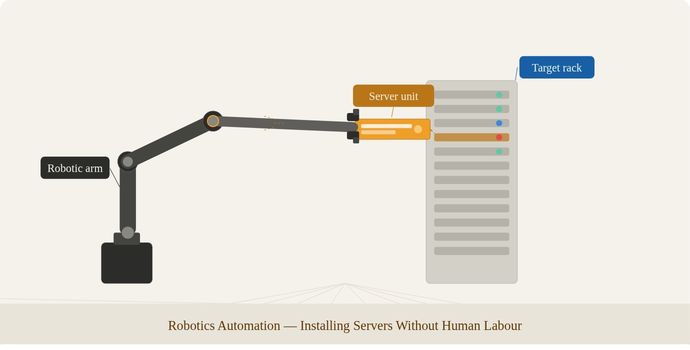
SoftBank sees a result: automate the entire process with
robotics. Rather than counting on mortal construction
crews and homemade garçon installation, SoftBank’s new
adventure aims to use robotics systems to make,
maintain, and operate data centres at a speed and scale
that simply are not possible at the moment.

“The company that controls AI structure controls the future
of digital frugality. SoftBank is placing a veritably deliberate
bet on being that company.”
suppose about what this means virtually. A
robotics-powered data centre could theoretically be
stationed briskly, operated with smaller staff, and be
maintained more constantly than a mortal-run installation.
Robots do not get tired. They do not make installation
crimes after a 12-hour shift. And they can operate
continuously in surroundings with extreme cold waves,
high voltage, and thick garçon racks that are authentically
delicate for humans.
Why SoftBank — and Why Now?
Is SoftBank the right company to pull this off – or is this
another Vision Fund-style moonshot that sounds more on
a whiteboard than in the real world?
It is a fair question. SoftBank has had its share of
spectacular failures — WeWork being the most notorious.
But the company has also demonstrated a sharp instinct
for relating transformative technology at exactly the right
moment. Its early investment in Alibaba returned hundreds
of billions. Its adoption of ARM architecture gave it a
stranglehold on the chip architecture powering nearly
every smartphone and AI chip on earth.
And then there is the thing that SoftBank formerly owned:
ARM. That gives the new robotics data centre adventure
an extraordinary advantage. ARM’s chip designs power
the processors inside the most effective AI writers’
moments. A company erecting AI data centres that run on
ARM-grounded tackles – and are possessed by the same
parent – has a position of perpendicular integration that
Amazon and Google can only dream of replicating
snappily.
SoftBank also owns significant stakes in robotics
companies, including a deep relationship with Boston
Dynamics, and coterminous technologies and investments
across the global robotics ecosystem through the Vision
Fund. The pieces, in other words, were formerly on the
board. This new company is SoftBank assembling them
into a single, coherent strategy.
The $100 Billion IPO Ambition or
Literalism?
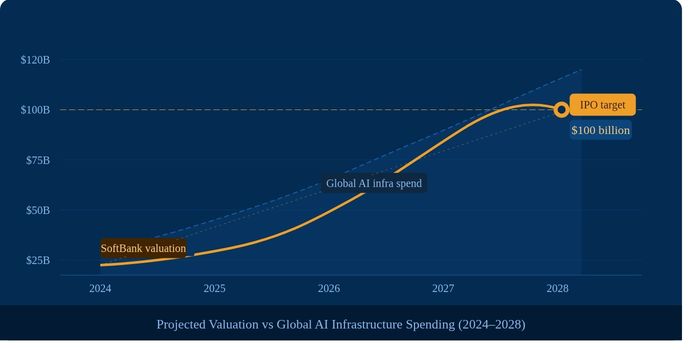
Let us talk about the number that stopped everyone in
their tracks: 100 billion. That is the reported IPO valuation
SoftBank is formerly eyeing for this new adventure. To put
it in an environment that would make it one of the largest
IPOs in history at launch—before it has indeed completely
erected its first installations.
Is a 100 billion valuation justified for a company that is still
in its early stages? Or are we watching AI hype inflate
another dangerous bubble?
The sceptics have a point. We have seen sky-high
valuations deteriorate ahead. But consider the request
environment: AI structure is presently one of the most
capital-starved sectors on Earth. Possible spelling mistake
found. are spending 50 – 80 billion annually on data centre
build-out and still cannot meet demand. Any company that
credibly promises to accelerate that build-out at lower cost
– using robotics isn’t dealing with a dream. It is dealing
with a result to a veritably real, veritably precious problem.
AI structure spending is projected to exceed 300 billion by
2028. Possible spelling mistake found. SoftBank’s robotics
data centre company, if it executes well, could capture a
meaningful slice of one of the largest capital expenditure
thunderclaps in ultramodern profitable history.
That is the bet. And at 100 billion, SoftBank is basically
saying, ‘We believe we can dominate a significant portion
of that request.’ Whether investors agree will depend
entirely on prosecution — but the strategic sense, at least,
is sound.
What This Means for the Broader AI
Race
SoftBank’s move signals commodity importance about
where the real competition in AI is heading. For once,
many times, the public narrative has concentrated on the
AI model race — OpenAI vs Google vs Anthropic: who has
the smartest model, the stylish chatbot, the largest
parameter count? But the astute players in the assiduity
have always known that the real constraint is structure.
You can make the world’s most sophisticated AI model,
but if you do not have enough cyphers to train it, run it,
and serve it to millions of druggies contemporaneously, it
does not count.
The tailback was in no way the algorithm. It was always
the tackle, the power, the cooling, and the physical space.
SoftBank is attacking that tailback directly.
By automating data centre construction and operation, the
company could dramatically compress the timeline from
‘We need more cyphers.’ “More cyphers are online.” That
is a competitive advantage with compounding goods. A
brisk structure means faster AI development, which means
faster profit, which funds further structure.
The Risks Worth Watching
No analysis of this adventure would be complete without
admitting the pitfalls. Robotics at this scale is authentically
hard. Erecting a robot that can install a garçon rack
reliably in a controlled terrain is one thing. Planting that
system across dozens of installations in different countries
and climates. Possible spelling mistake found.
Surroundings are another thing entirely.
There are also geopolitical confines. Data centres are
now considered critical public structures in utmost major
husbandry. Governments are decreasingly scrutinising the
foreign power of data structure — and SoftBank, as a
Japanese empire with deep ties to Saudi Arabia’s Public
Investment Fund, will face questions in every request it
enters.
And also there is the prosecution threat that has visited
SoftBank ahead. Masayoshi Son has an extraordinary
capability to identify the right trend – but the Vision Fund
period showed the troubles of moving too fast, too large,
with inadequate functional rigour. The robotics data centre
adventure will need strong leadership, sustained capital
allocation, and genuine specialised delivery to justify what
will really be violent investor scrutiny.
The Bottom Line:
SoftBank’s robotics data centre company is one of the
most strategically coherent bets in the AI structure space
right now. It combines the company’s being, meaning
ARM’s chip armature; robotics investments; and a long
track record of relating transformative shifts into a single,
focused adventure targeting one of the largest unsolved
problems in the global technology industry.
A 100 billion IPO is an extraordinary target for a company
still changing its bases. But in a world where AI cypher
demand is growing exponentially and the race to make
brisk, cheaper, more effective data centres is enhancing
every quarter, the ambition is at least matched by the
occasion.
References:
TechCrunch — “SoftBank is creating a robotics company that builds data centers — and already eyeing a $100B IPO”
CNBC — “SoftBank reportedly weighs $100 billion valuation for new AI and robotics spinout in potential U.S. IPO”
CoinAlertNews — “SoftBank Launches $100B AI and Robotics Company Roze, Targets 2026 IPO”
Bricks & Bytes—”SoftBank’s $100B Robotics Bet: Why Roze AI Wants to Build the Data Centers AI Runs On”
Yahoo Finance—”SoftBank plans robotics and AI firm in the US to build data centers.”